Ultra-fast agile RF synthesis
Supports frequency, amplitude, and phase modulation with up to 10MHz analogue modulation bandwidth.
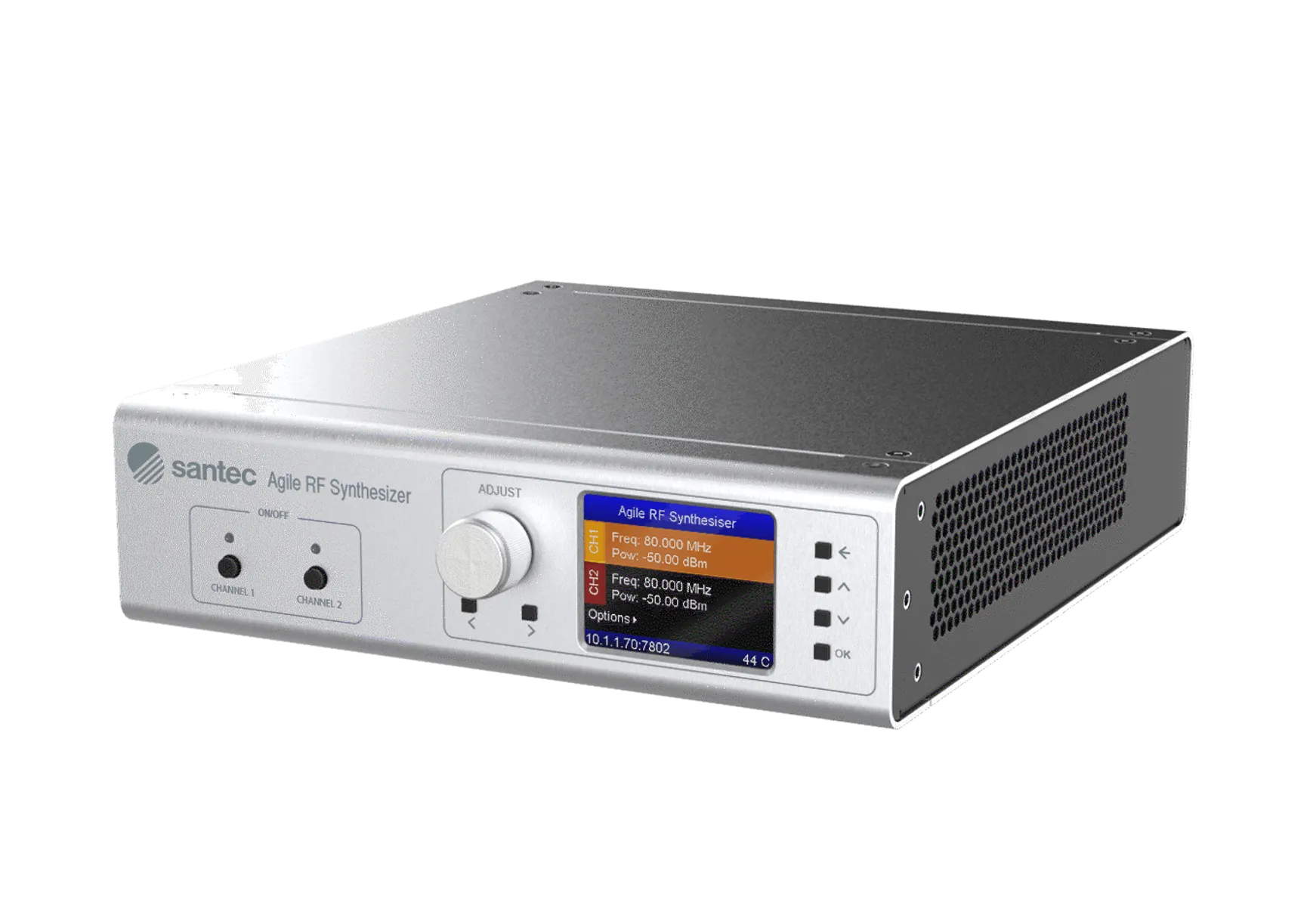
High-speed, agile RF generation for precision optical control and quantum systems
The XRF RF synthesizer from Santec is a high-performance, multi-channel RF source designed for advanced optical and quantum experiments. It combines ultra-fast frequency agility with precise amplitude, phase, and frequency modulation, enabling complex waveform generation for AOM control, laser stabilisation, and quantum manipulation.
Built around FPGA-driven DDS architecture, the XRF delivers exceptional flexibility and stability in a compact, robust platform suitable for both laboratory and experimental research environments.
Supports frequency, amplitude, and phase modulation with up to 10MHz analogue modulation bandwidth.
Two independent channels covering 20-400MHz, with up to 4W (+36dBm) output power.
Frequency range extends down to 15kHz for low-power precision applications.
Supports complex FM/AM/PM sequences with interpolation, loops, ramps, and external triggers.
Dual AD9910 DDS cores enable precise timing control with high resolution and stability.
Built-in PID functionality enables laser noise suppression and optical stabilisation (“noise-eating”).
Ethernet/USB interface supports full parameter control and programmable sequence playback via Python, MATLAB, and LabVIEW.
The XRF can function as a standalone RF source or integrate into larger optical and quantum control systems. It is commonly used to drive AOMs directly or as part of feedback loops for laser stabilisation and quantum state manipulation.