Ultra-narrow linewidth (down to sub kHz)
Supports high-coherence applications such as interferometry, precision spectroscopy, and quantum systems
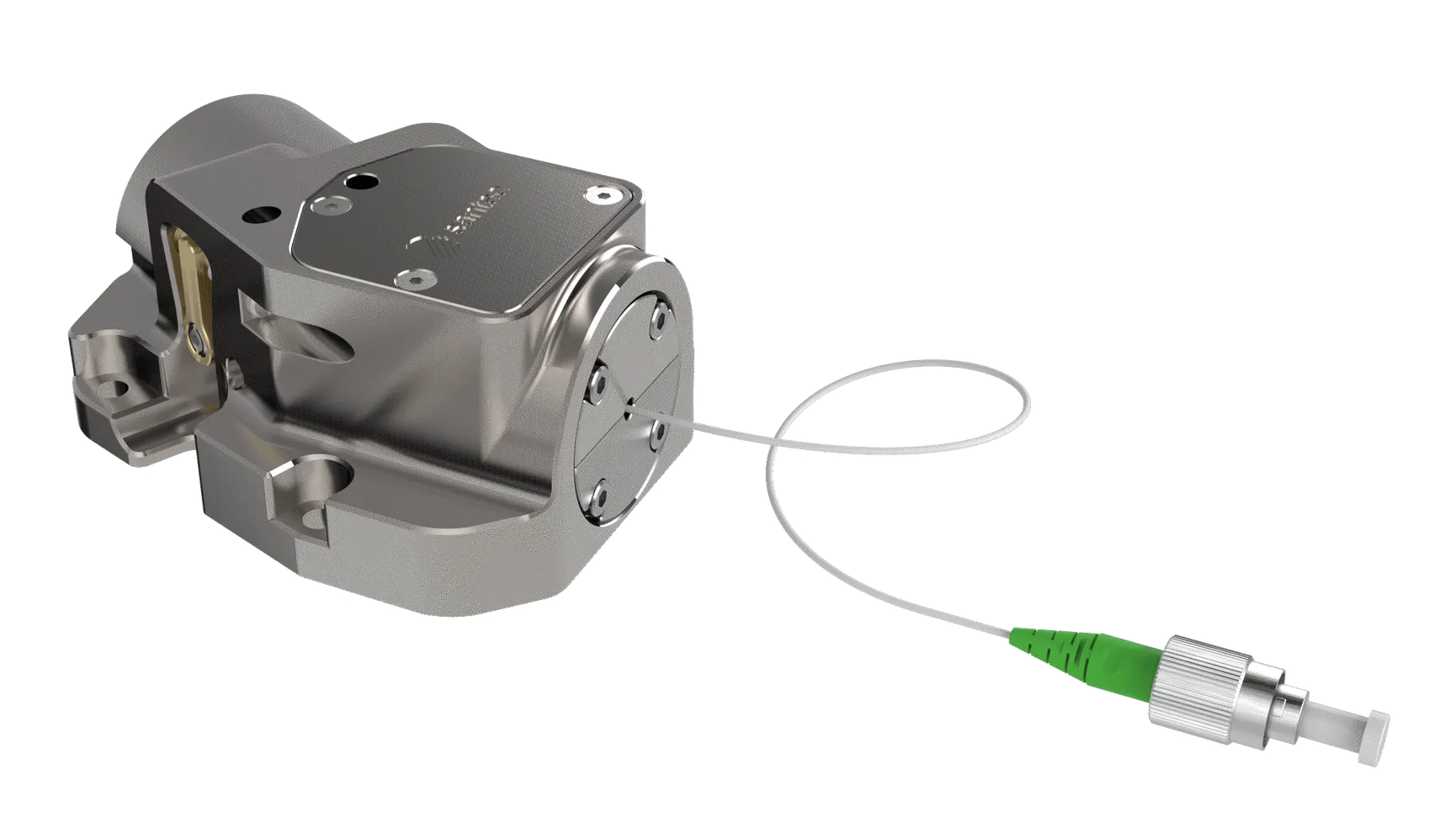
Ultra-narrow linewidth lasers with wide tunability and turnkey integration
The CES series from Santec delivers ultra-low linewidth performance in a compact, fibre-coupled format. Combining cateye filter technology with single angled facet (SAF) laser diode , CES lasers achieve exceptional coherence and stability while maintaining broad wavelength tunability.
With fibre coupling integrated into the helf butterfly packaged diode itself, and optional internal isolation, the CES provides a ready-to-use solution for precision applications requiring both performance and ease of integration.
Supports high-coherence applications such as interferometry, precision spectroscopy, and quantum systems
Covers a wide spectral range from 1000nm to 1970 nm, enabling flexibility across multiple applications and atomic transitions.
Delivers stable, alignment-free output directly into fibre systems, simplifying experimental setups and system design.
Many configurations include an internal Faraday isolator to minimise feedback sensitivity and improve stability.
Combines the stability of cateye filtering with the reliability of butterfly-packaged SAF diodes in a turnkey laser module.
CES systems support an integrated laser diode controller (mLC), internal isolator and fibre-coupled output, enabling a compact, all-in-one laser solution with USB or TCP/IP connectivity.
CES lasers are designed for seamless integration into fibre-based systems. They can directly seed optical or fibre amplifiers for power scaling or be used with nonlinear conversion modules to generate visible and mid-infrared wavelengths through harmonic generation and mixing.