Back to top
-
  • CEL

Cateye Tunable Diode Lasers

  • Linewidth <100 kHz with low noise performance
  • Broad wavelength coverage from 630-1100 nm 
  • Compact configurations with integrated control options
  • Self aligning cateye design and ultralow wavelength sensitivity ensures long term stability
  • Optional intracavity modulator for ultimate high speed feedback
CEL

Description

Stable, narrow-linewidth tunable lasers with wide wavelength coverage

The CEL series delivers highly stable, narrow-linewidth laser output across a broad wavelength range, making it ideal for precision spectroscopy, quantum technologies, and advanced photonics research.

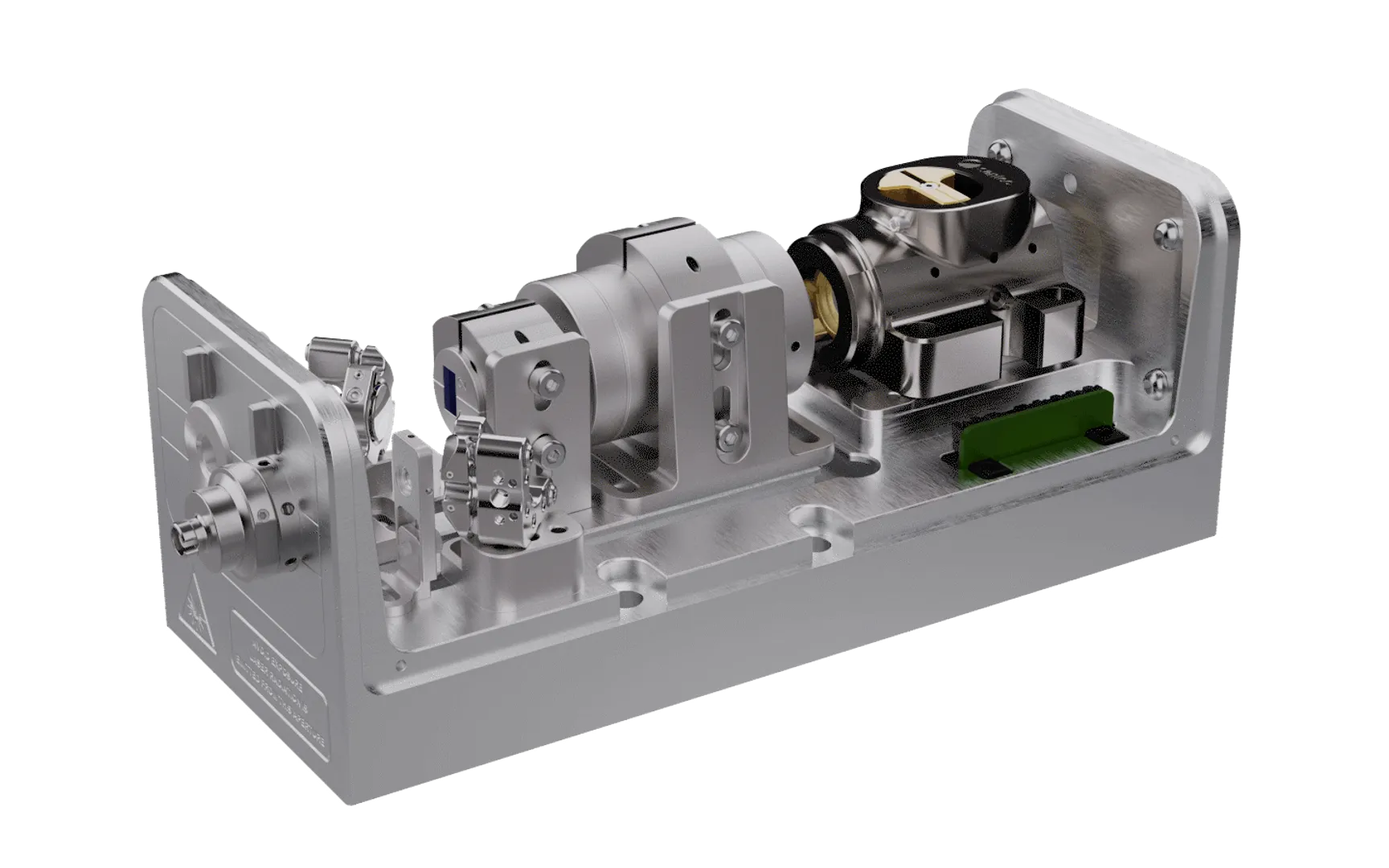
Built on a proprietary cateye resonator design, CEL lasers provide the robustness of DFB/DBR sources while maintaining the wide tunability and flexibility of external cavity systems.

Exceptional stability without realignment

The cateye architecture replaces traditional diffraction gratings with a self-aligning reflector and ultranarrow filter, enabling tuning over tens of nanometres without re-alignment, and an angular wavelength sensitivity an order of magnitude smaller than a Littrow

Ultra-narrow linewidth performance

When paired with Santec’s control electronics, CEL lasers achieve free running linewidths well below 100 kHz, supporting high-resolution spectroscopy and coherence-sensitive applications.

Wide wavelength and power range

Available from 630 nm to 11620 nm, with output powers up to 250 mW (extra-cavity), covering a broad range of experimental requirements.

Compact, integrated control options

CEX/CEF variants support integrated Laser diode controllers (mLC), optical isolators and fibre coupling, enabling a compact, all-in-one laser solution with USB or TCP/IP connectivity.

Applications

  • Precision spectroscopy
  • Quantum optics and atomic physics
  • Laser cooling and trapping
  • Nonlinear optics and frequency conversion (SHG, SFG, DFG)
  • Seeding of semiconductor amplifiers and fibre amplifiers

System Integration

CEL lasers are designed for seamless integration into advanced photonics systems. They can be paired with semiconductor amplifiers or fibre amplifiers for power scaling, or with frequency conversion modules to access visible and UV wavelengths via second harmonic and nonlinear mixing processes.