
SiPh PIC Development
Silicon photonics development depends on how quickly a team can move from measurement to understanding. Engineers need to verify spectral and polarization behavior, observe coupling and reflection effects in situ, and isolate where loss is introduced before packaging or system integration hides the cause. This application supports fast, software-driven SiPh PIC characterization—from single-device debug to complex multi-port evaluation—using swept measurement, spatially resolved analysis, and flexible optical conditioning.
Explore Application Solutions
SiPh/PIC development: controlled optical interrogation, not spectral capture
In silicon photonics development, the measurement problem that costs the most time is not a bad result. It is a result that cannot be trusted. A ring resonance that looks too broad, a coupler that looks lossier than simulation, a filter edge that shifts between measurements: any of these might be real device behavior, or they might be bench artifacts. The wrong diagnosis sends a design team into a layout revision that was never needed.
A credible SiPh/PIC development workflow is therefore not primarily about measurement speed or port count, though both matter. It is about building enough control over the optical environment that the measured behavior can be attributed to the device with confidence, and about having the diagnostic capability to localize problems when the spectrum alone is ambiguous.
Spectral characterization with enough margin to see through the bench
The first requirement is clean swept characterization of the structures that define device behavior: rings, interferometers, AWGs, splitters, couplers, routing elements, and wavelength-selective blocks. In development, the relevant questions go beyond whether a feature exists. Center wavelength accuracy, linewidth, extinction ratio, passband shape, ripple, and port balance all need to be measured with enough fidelity to support a design decision, not just a go/no-go flag.
The TSL-570 family is built around fast, high-accuracy swept measurement with sub-picometer resolution. The Type H variant adds +20 dBm output power, which matters in early-stage SiPh work specifically because grating coupler losses, fiber-to-chip interfaces, and bench insertion losses are all non-trivial, and losing engineering visibility into narrow spectral features because of insufficient optical margin is a real failure mode, not a theoretical one.
Locating the problem, not just observing it
When a transfer function looks wrong, the question that follows immediately is whether the problem is in the device or in the measurement path. In SiPh development, that distinction is not always obvious from the spectrum alone. A resonance distortion, an unexpected insertion loss step, or a passband asymmetry can each originate from multiple causes: a fabrication defect in the waveguide, a localized reflection, a propagation loss change, or a coupling artifact that has nothing to do with the chip.
The SPA-110 is Santec's OFDR-based platform for this layer of diagnosis, with 5 µm sampling resolution and the ability to report reflectance, transmission, propagation loss, and distance to optical events directly along the photonic path. For development teams, the practical value is that it shifts the debug question from "what does the spectrum look like" to "where in the structure is the anomaly originating," which is a much more actionable input for the next design iteration.
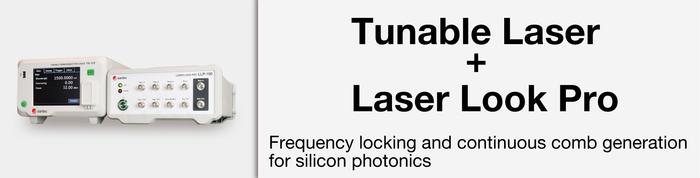
Tunable Laser + Laser Lock
A laser frequency control add-on designed for use with santec's TSL-570 laser system. It offers precise frequency locking capabilities by processing an electrical error signal derived from an extra frequency reference. In Auto-lock mode, various control sequences can be automated; including lock point search, engagement, monitoring, and relocking.
Multi-port comparison that stays valid across the sweep
Many PICs under development are not single-path devices. Splitter trees, AWGs, MZI networks, and wavelength-routing elements generate multiple outputs that need to be compared against each other, and that comparison is only meaningful if all outputs were measured under the same spectral sweep and the same reference conditions. Serial measurement with re-seating between ports does not satisfy that requirement.
The MPM-220 supports simultaneous acquisition across up to 20 ports with up to one million logging points per port and real-time referenced insertion loss when paired with a Santec tunable laser. Port-to-port differences measured this way are engineering data. Port-to-port differences measured serially under shifting conditions are noise that looks like engineering data.
Controlling the optical stimulus, not just recording the response
Early PIC development often requires more than sending a swept signal through a device and capturing the output. Isolating a narrow spectral region, probing a filter edge under a defined input condition, observing how a device responds when adjacent channels are present, or emulating a specific optical environment are all experiments that require programmable control over the input, not just a tunable laser.
The OTF-980 supports independent tuning of center wavelength and bandwidth with filter slopes up to 1000 dB/nm (typical), and an integrated peak-search function that simplifies alignment around narrow features. The WSS-2000 adds LCOS-based programmable filtering with 0.78 GHz setting resolution, 400 dB/nm filter slope, configurable switching, and optional phase control. Together, these instruments turn the development bench from a passive measurement chain into a configurable optical environment where the input condition is part of the experiment.
Wavelength Stability and Spectral Fidelity in High-Q Characterization
In high-index-contrast silicon photonics, particularly when characterizing high-Q resonators or steep-edge filters, spectral uncertainty is frequently a function of source instability rather than intrinsic device physics. Thermal drift or sub-picometer fluctuations in the tunable laser’s absolute wavelength during a sweep can convolve the source profile with the device response. This manifests as an apparent broadening of resonances, artificial asymmetry in the transfer function, or poor correlation between successive scans.
To mitigate these artifacts, a closed-loop frequency-locking architecture is required to reference the tunable source against a stable external standard. Integrating this stage into the measurement environment allows for deterministic source placement. For experiments requiring long-term stability at a specific resonance peak or feedback-sensitive characterization, this stabilization layer ensures that observed spectral shifts are attributable solely to the device under test (DUT), effectively removing the interrogation source as a variable in the error budget.


