Ultra-fast agile RF synthesis
Supports frequency, amplitude, and phase modulation with up to 10MHz analogue modulation bandwidth.
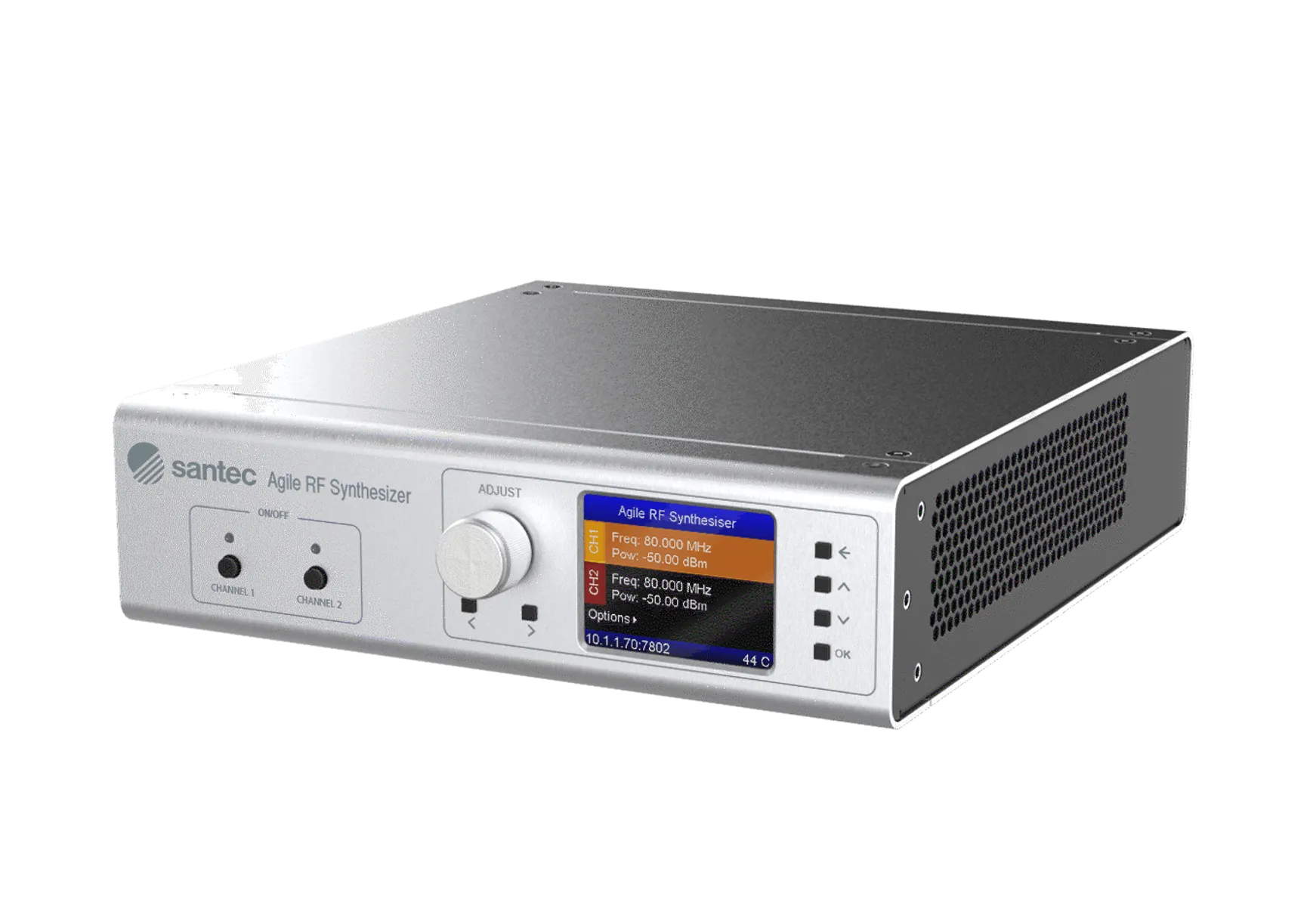
高速RFシンセサイザ(XRF)は、高速 (10 MHz帯域) アナログ変調による周波数・振幅・位相制御を特長とする、高機動RF光源です。量子イオン、BEC、冷却原子実験の要求に応える俊敏性と堅牢性を備え、AOMドライバとしても、光ノイズイータ (PID内蔵) としても単体で使用可能です。高出力RFアンプを内蔵した2チャンネル構成で、各チャンネルは20~400 MHz (最大4 W / +36 dBm) をカバーし、低出力では15 kHzまで対応します。前面ノブによる手動操作に加え、FM/AM/PMの同時変調 (10 MHz、完全アンチエイリアス) やサーボフィードバックにより、周波数ロックやノイズ抑制を簡便に実装できます。Ethernet/USB経由の制御では、高分解能 (周波数0.23 Hz、振幅0.2 mW、位相0.4 mrad) での高速チャープや任意波形生成 (最短16 ns) に対応。16系統のデジタルI/OをDDSシーケンスと同期させられ、複雑な実験時系列を一体制御できます。FPGA駆動DDSと独立マイコン通信により、高性能と高信頼性を両立したRFソリューションです。
Supports frequency, amplitude, and phase modulation with up to 10MHz analogue modulation bandwidth.
Two independent channels covering 20-400MHz, with up to 4W (+36dBm) output power.
Frequency range extends down to 15kHz for low-power precision applications.
Supports complex FM/AM/PM sequences with interpolation, loops, ramps, and external triggers.
Dual AD9910 DDS cores enable precise timing control with high resolution and stability.
Built-in PID functionality enables laser noise suppression and optical stabilisation (“noise-eating”).
Ethernet/USB interface supports full parameter control and programmable sequence playback via Python, MATLAB, and LabVIEW.