
Cable Assembly
Cable assemblies are judged in production, not in a lab demo. This application focuses on production-grade verification of insertion loss, return loss/backreflection, and polarity (fiber mapping)—from simplex and duplex jumpers to high-density multifiber assemblies such as MPO/MTP—using stable measurement methods, controlled launch conditions, and automation-ready switching to keep results consistent across operators, shifts, and sites. The objective is straightforward: fast pass/fail decisions with traceable records that reduce rework and protect downstream system performance.
Explore Application Solutions
Cable assembly testing is metrology under time constraints
In cable assembly, the technical challenge is not “measuring loss.” It is measuring loss and reflection in a way that stays repeatable under high throughput, while also proving correct fiber mapping/polarity for multifiber products. That means controlling the full chain: launch condition, reference method, reconnections, operator steps, and data traceability—not just the instrument headline spec.
Santec’s approach is built around production realities. We have been manufacturing fiber optic cable assembly test equipment since 2002, and the platform is designed to scale from benchtop stations to automated cells with switching, barcode workflows, and database-backed logging.
What a cable assembly test must prove
1) Insertion Loss (IL)
Optical Return Loss Meter
The RLM 100 is ideal for production and lab environments. The redesigned integrating sphere detector can measure RL loss on dense 72-channel MTP/MPO and duplex LC connectors with a single connection.
IL is the fastest signal-quality gate, but it’s also where production variability shows up first: endface condition, polishing quality, ferrule alignment, and connector mating effects. For multi-wavelength requirements, production testing often needs two wavelengths without doubling operator time—e.g., dual-wavelength IL only measurements can be completed in under one second on an ILM-100 configuration.
2) Return Loss / Backreflection (RL/BR)
Reflections are a system problem: they can degrade link margin, create noise penalties in sensitive links, and trigger transceiver instability in reflection-sensitive architectures. In production, RL measurement must remain robust even when DUTs are short, connector types vary, and parasitic reflections would normally distort results.
As data rates increase, so does the requirement to measure RL on all cable assemblies. It has become industry standard across most applications that all cables need to be tested for IL and RL. The RLM-100 is OTDR based and twice as fast as other premium test solutions while maintaining the same accuracy. With other key features like user self-calibration, it’s no wonder the RLM has become adopted globally as the standard in cable assembly IL/RL Testing.
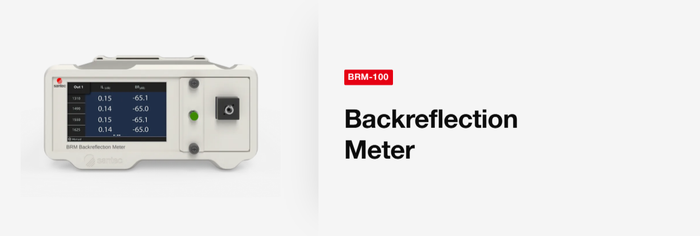
For more customized applications where wavelength and fiber types may vary, or passive components such as fiber array units, the Backreflection meter, BRM-100, is an alternative OCWR solution. With extremely stable optics and customizability, we have the best instrument designed for every application.
3) Polarity / Fiber mapping (especially multifiber)
The most common failure of multifiber cable assemblies is polarity. An operator incorrectly loading one fiber during connectorization can require a rework of that connector. A quick pass/fail on polarity is critical to high volume testing efficiency. The combined integrating sphere and polarity detector for the RLM-100 (RLM with “SP” detector option) lets you test IL, RL and polarity in a single step. An fast pass/fail on polarity can be set before automatically continuing to IL/RL.
The hidden variable: launch conditioning and measurement repeatability
If you test multimode assemblies (or any situation where launch distribution matters), repeatability depends on whether launch conditions are controlled to the required standard. Santec’s launch conditioning tooling is explicitly positioned to meet industry-specified launch conditions (including encircled flux and other standards-driven conditions), because you can’t “software-average” your way out of a launch problem.
Multimode RLMs, BRMs and ILMs are internally conditioning aligned to IEC 61280-4-1 Encircled Flux standard.
Throughput without sacrificing rigor: reduce reconnections, reduce reference complexity
A practical production rule: every extra reconnection is a chance to add variability (and a chance to inject delays, mistakes, or contamination handling steps). That’s why modern cable assembly stations trend toward “single connection” workflows and integrated sequences.
Santec’s RD-P / RD-SP concept is explicitly aimed at reducing station complexity while keeping measurement integrity: add the remote-head detector into an RLM + optical switch architecture, then test IL, RL, and polarity on multifiber assemblies (e.g., MPO/duplex LC) while keeping results stored together.
RD-SP also describes a production-oriented sequence where a successful polarity + IL + RL test on a 12-fiber assembly at two wavelengths can be completed in under 35 seconds.
Automation and traceability: credibility comes from the record, not the screenshot
Manufacturing credibility is earned when you can answer: What did we measure, how did we reference it, who tested it, and can we retrieve it later?
Santec’s Cable Assembly software is described as the operator interface that controls the relevant instruments (RLM, OSX, RD-P, PTM) and uses the XNS database as the storage backbone—so IL/RL/polarity results live in one traceable record.


